Why Your Instagram Likes Dropped — and How to Fix It Fast
You didn't change anything. That's what makes it so disorienting. Same account. Same posting schedule. Same type of content that was working perfectly well three weeks ago. And then, without warning or explanation, the likes started coming in slower. Then slower still.
You've refreshed the post seventeen times. You've gone down a rabbit hole of Reddit threads where everyone has a different theory and nobody has a definitive answer. You've wondered if the account is somehow shadowbanned.
People reach for the shadowban explanation when the actual cause is something far more specific and far more fixable. Or they tweak the wrong variable, see no improvement, and conclude the platform has permanently changed in a way that disadvantages them. Most of the time, the drop has a specific cause. Most of the time, the cause is identifiable. And most of the time, the fix exists — provided you're diagnosing the right problem. This guide goes through all of it.
Before Anything Else: Understand What Instagram Is Actually Measuring
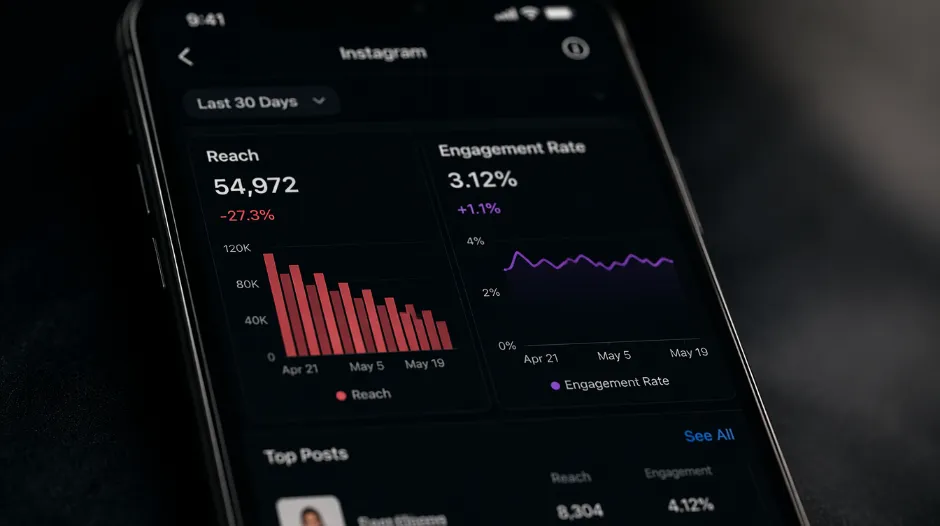
Instagram likes are not a direct measure of how many people liked your content. They're a measure of how many people who were shown your content chose to engage with it in that specific way. The variable that most often changes when your likes drop is not how much people like your content. It's how many people are being shown your content at all.
Reach is down, engagement rate is stable
Your content is being shown to fewer people than before, so the absolute like count has dropped even though your engagement rate might be roughly stable. This is a distribution problem — the algorithm has reduced how widely your content is being served, not a reflection on content quality.
Reach is stable, engagement rate has dropped
The same number of people are seeing your posts but fewer are engaging with them. This is a content or audience alignment problem — something about your content has stopped resonating with the audience currently seeing it.
Look at reach alongside engagement before you change anything. If your reach is down and your engagement rate is roughly stable, you have a distribution problem. If your reach is stable but your engagement rate has dropped, you have a content or audience alignment problem. The treatment differs in each case — conflating them leads to solutions that address the wrong problem and leave the actual cause intact.
The Algorithm Shift — The Cause Everyone Blames and Nobody Fully Understands
The algorithm explanation is the most invoked and the least specific response to an Instagram engagement drop. "The algorithm changed" has become the social media equivalent of "act of God" — an explanation that attributes the event to a force too large and unknowable to meaningfully respond to.
The frustrating reality is that the algorithm explanation is sometimes correct. The algorithm shift that occurred in early 2026 specifically reduced the organic reach of accounts relying heavily on static image posts without accompanying Reels or carousel content. If your content mix is primarily single-image posts, this shift specifically affected you.
It favours content that keeps people on the platform longer, content that generates saves and shares over passive likes, content that creates genuine engagement through comments and replies, and content in formats — specifically Reels and carousels — that it's been actively promoting. If your content was optimised for likes — aesthetically pleasing but not particularly useful, entertaining without being shareable — the algorithm's evolution toward save-and-share prioritisation will have hit you harder than creators who were already making content worth saving.
Your Posting Frequency Changed — More Is Not Always More
This surprises people consistently. Instagram's algorithm builds a model of your account's performance over time. When you establish a posting rhythm — posting three times per week for several months — the algorithm calibrates its distribution expectations around that rhythm. When you suddenly post seven times a week, you're fragmenting your audience's attention across more posts than they've been conditioned to engage with, which typically means the per-post engagement average drops even as total content volume increases.
More problematically, posting more frequently when your engagement rate has already dropped can actively signal to Instagram that your content is underperforming at scale rather than in isolation. If the algorithm sees a sustained pattern of low-engagement posts, it begins to reduce your default distribution, creating a self-reinforcing cycle where lower likes lead to lower reach lead to lower likes.
Pick a posting schedule that's sustainable indefinitely and maintain it with as little variation as possible. Three excellent posts per week held consistently for six months will dramatically outperform any strategy that fluctuates between overposting and underposting based on schedule or motivation ebbs. The algorithm rewards predictability. Give it something reliable to build a distribution model around.
Your Audience Has Changed But Your Content Hasn't
Instagram's audience is not static. The followers you have today are not behaviourally identical to the followers you had twelve months ago — even if the account names in your follower list are mostly the same. What resonated with your audience when you built it doesn't always resonate with the same intensity twelve or eighteen months later.
The specific version that causes the most confusion is account drift. You started posting one type of content, built an audience around it, and then gradually shifted your content direction as your interests and expertise evolved. The audience stayed — people don't typically unfollow accounts proactively unless the change is dramatic — but their engagement declined because the new content doesn't match what they followed for.
Compare your most recent twenty posts to your highest-performing historical content. What changed? Topic, format, tone, visual style? The fix is either returning to a content direction your audience genuinely came for, or accepting a reset period during which you rebuild your audience around the new direction — understanding this rebuild takes time and will manifest as a temporary engagement trough before new, better-matched followers generate engagement levels that match your current content.
Your Content Stopped Being Worth Saving
This is the single most impactful and most correctable cause of declining Instagram likes in 2026 — and it requires the most honest self-assessment. Instagram's algorithm weights saves and shares more heavily than likes when determining how widely to distribute content. As Instagram has shifted its distribution priority toward save-and-share content, posts that don't generate saves are simply being shown to fewer people. Fewer impressions mean fewer likes, even if your content quality is unchanged.
The practical question: when did you last post something that someone would genuinely want to save?
Saving behaviour is driven by utility and reference value. People save posts they want to revisit: recipes they might cook, workouts they might try, tips they might apply, quotes they want to return to, information they'll need later. Entertainment content — funny, beautiful, emotionally resonant posts — gets likes but rarely gets saves unless there's something in the content that has future reference value.
Educational posts in your niche, resource compilations, step-by-step guides, before-and-after transformations, comparison breakdowns. Not abandoning what makes your account distinctively yours — adding a layer of content that gives your audience a reason to press save rather than just like. The indirect effect of higher save rates is higher distribution, which means more impressions, which means more likes even on your non-educational content. Saves don't just reward the posts that generate them. They build algorithmic trust that lifts your overall account's distribution.
The Shadowban Question — What It Actually Is and Whether It's Happening to You
The shadowban is the explanation that gets reached for first and is the actual cause least often. But it is a real phenomenon, and it's worth understanding accurately.
A shadowban on Instagram is not a formal account action. It's a colloquial term for a situation where Instagram's systems have quietly reduced your content's distribution — specifically its hashtag discoverability and Explore page appearance — without taking any formal account action or notifying you. The result: your content continues to appear to your existing followers but stops being discoverable to new audiences.
The behaviours that most reliably trigger shadowban-adjacent treatment in 2026 include using banned hashtags (perfectly innocuous-seeming tags can be banned if heavily abused), using the same fixed hashtag set on every post (resembles bot behaviour), aggressive follow-unfollow activity, getting reported by multiple users, and sudden changes in account behaviour after a period of inactivity.
Post using a niche, low-volume hashtag, then check that hashtag feed from a different account that doesn't follow you. If your post appears, your hashtag discoverability is working. If it doesn't, your account may be experiencing reduced distribution. The fix is a period of behavioural normalisation: stop using hashtags for one to two weeks, stop any follow-unfollow activity, engage genuinely within the platform, post high-quality content consistently. Most accounts report reduced distribution lifting within two to four weeks of normalised behaviour.
Your Hashtag Strategy Stopped Working
Even without the shadowban scenario, hashtag strategy that worked eighteen months ago may be actively underperforming in 2026's Instagram environment. Instagram's algorithm has significantly de-emphasised hashtag-driven discovery in favour of interest-based content matching. The platform now has enough data on your content's visual characteristics, caption semantics, and engagement history to categorise and distribute your posts based on content signals rather than hashtag metadata.
The hashtag practices that are actively hurting engagement in 2026 are the ones that pattern-match to spam behaviour: using thirty hashtags on every post, using the same thirty hashtags on every post, using high-volume mega-hashtags where your content is buried within seconds of posting.
Three to ten hashtags, specifically relevant to the individual post rather than generically relevant to your account. Mix small-niche hashtags where your content has a genuine chance of being seen with medium-volume category hashtags. Avoid hashtags with hundreds of millions of posts. Vary your hashtag selection meaningfully between posts so the pattern doesn't look automated. If your like drop correlates with a change in your hashtag strategy, returning to smaller, more varied, more curated usage often produces engagement recovery within one to two weeks.
The Timing Problem Nobody Thinks to Check
Timing is the variable that affects Instagram likes most invisibly because it never causes a visible change. The post looks the same. The content is the same. The audience is the same. The only thing that changed is when the post appeared in relation to when that audience is actually on the app.
Instagram's algorithm gives every post an initial distribution window immediately after publishing. The engagement generated in the first one to two hours determines whether the algorithm expands distribution or limits it. If your posting time has shifted — even by two or three hours — and that shift moved you out of your audience's peak activity window, your initial engagement rate drops, which suppresses algorithmic amplification, which reduces total reach, which reduces total likes.
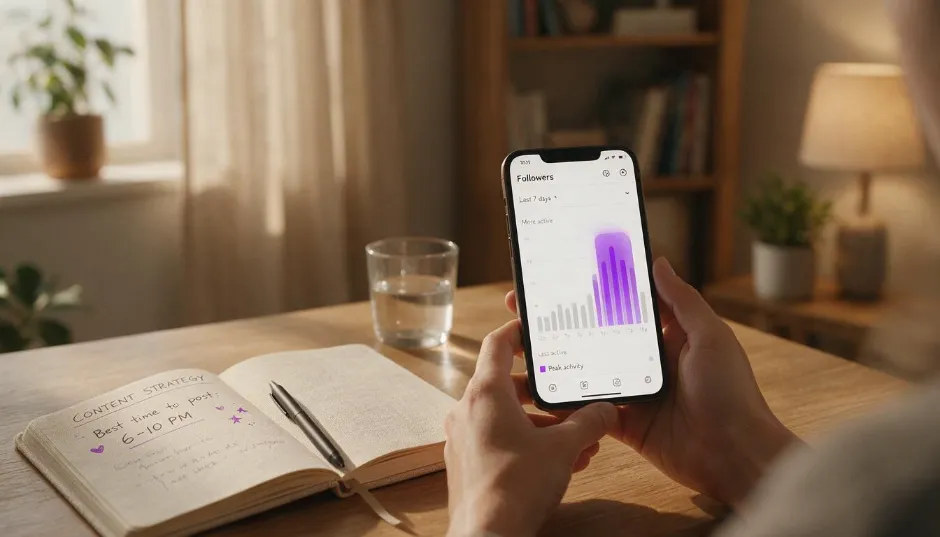
Look at your Instagram Insights under "Total Followers" where Instagram shows you the hours and days when your followers are most active. This data is specific to your account and often different from the general guidance about best posting times. Your followers might be most active at 8 PM on Tuesday. The general guidance might say post at 9 AM. Only your own data can tell you which is true for your specific audience. Test posting at three different times over three weeks and track engagement in the first two hours of each post. Your own data is more reliable than any general advice.
The Content Format Mismatch
Instagram in 2026 is a multi-format platform that treats its different content types very differently in terms of algorithmic distribution. If your content mix isn't aligned with how Instagram is currently prioritising formats, your likes will reflect that misalignment.
| Format | Algorithm Priority | Why |
|---|---|---|
| Reels | Highest | Instagram is actively trying to grow Reels viewing to compete with TikTok and YouTube Shorts — giving Reels content preferential distribution. A Reel from a 10K-follower account can reach 200K people if it performs well in its initial test. |
| Carousels | High | Instagram shows carousel posts multiple times to the same user — once when first seen and again if they didn't swipe through all slides. This double-exposure increases the engagement window for carousel posts meaningfully versus single images. |
| Single Images | Medium | Not dead — great single-image content still performs — but fighting an uphill battle against algorithm preferences that favour motion and multi-slide content. The lowest-priority format in Instagram's current distribution hierarchy. |
| Stories | Separate feed | Operates on a different distribution logic entirely — primarily reaching existing engaged followers. Important for relationship depth and retention but not a primary reach driver for new audience discovery. |
If your content mix skews heavily toward single-image posts and your likes have dropped, introducing more Reels and carousels is likely to produce engagement recovery — not because the single images weren't good but because the format wasn't getting the distribution necessary to generate the likes they deserved.
Ghost Followers — The Silent Engagement Killer
Over time, every Instagram account accumulates a percentage of followers who are no longer active — accounts that were abandoned, profiles that became dormant, followers who installed the app during a specific life phase and stopped using it. These ghost followers continue to count toward your follower total without contributing any engagement.
Instagram's algorithm evaluates your content's performance against your follower base. If twenty percent of your followers are inactive accounts that never engage, your engagement rate against total followers is being suppressed by accounts that have no ability to engage. The algorithm sees a lower engagement rate and distributes your content less widely, which reduces likes.
Take the average likes and comments on your last ten posts, divide by your total follower count, and compare to industry benchmark for your account size — typically 1–3% for accounts in the 10K–100K follower range. If your rate is significantly below benchmark, ghost followers may be a compounding cause. The sustainable fix is focusing on content that attracts genuinely active followers going forward, which gradually improves your ratio, while running occasional engagement campaigns that re-activate dormant followers through interactive content like polls, questions, and challenges.
FAQ: Instagram Likes Dropped
The 4-Week Recovery Plan
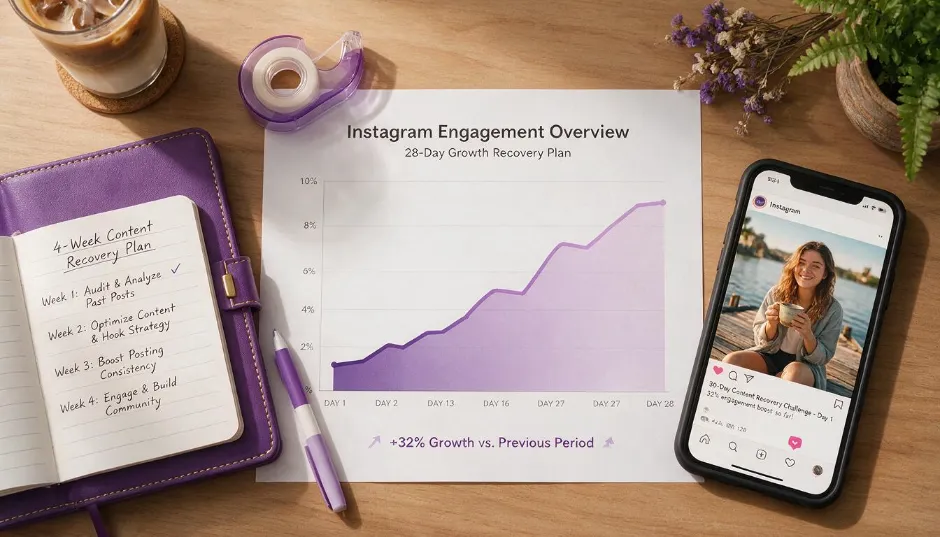
Diagnosing the cause is the intellectual work. The practical work is executing a recovery plan that addresses the most likely causes systematically without making the scattershot changes that confuse your account's pattern and slow recovery.
Do nothing except diagnose. Pull your Insights, compare reach data to the period before the drop, check your engagement rate against your follower count, test your hashtag discoverability from a separate account, and identify whether the timing of the drop correlates with any specific change — posting frequency, content format, hashtag strategy, visual style. The most important output of week one is a hypothesis about the primary cause.
Address the most likely cause while keeping everything else as stable as possible. If it's timing, adjust your posting time and track first-hour engagement on three posts. If it's format, introduce one Reel alongside your regular posts and compare performance. If it's content direction drift, return to the content type that historically generated your strongest engagement. Change one variable at a time so you know what's working.
Introduce a save-focused content type. A genuinely useful, reference-worthy post in your niche — a tips compilation, a how-to breakdown, a resource list — produces the save signals that start rebuilding algorithmic trust. Even one high-save post per week can meaningfully improve the distribution signals the algorithm is using to evaluate your account.
You should have enough data to see whether your hypothesised cause was correct and whether your intervention is producing recovery. Reach should be stabilising. Engagement in the first hour should be improving. Likes per post should be trending toward previous levels. If they're not, revisit the diagnosis — you may be addressing a secondary cause rather than the primary one.
The likes didn't drop because Instagram has something against you. They dropped because something in the signal picture your account is presenting changed — either because you changed something, or because the platform's weighting of different signals changed, or because your audience composition drifted. These are all diagnosable. They're all addressable. Find the cause. Make the change. Give it time. The likes will come back.
Need to Restore Your Instagram Social Proof During Recovery?
GetTwitterRetweet.com offers Instagram likes, followers, and story views with gradual quality delivery — helping close the visible engagement gap while your organic recovery strategy rebuilds the algorithmic signals that drive lasting growth.
Everything You Need to Restore Instagram Engagement
From the social proof signals that restore visible credibility to the reach and view metrics that support algorithmic recovery