Social Proof in Marketing: Why Numbers on Your Profile Matter More Than You Think
Table of Contents
There's a restaurant near where I used to work that had genuinely exceptional food. Quiet, tucked down a side street, no queue, always a few empty tables. Right next to it was a noisier place — louder music, higher prices, arguably worse pasta — that had a line out the door most evenings.
Guess which one closed during a slow winter.
The better restaurant was invisible. The busier one was broadcasting something the other couldn't manufacture: evidence that other people had already decided it was worth their time. You didn't need to evaluate the menu or read reviews. The queue did the persuasion for you.
And it is running far more of your audience's decisions than either you or they would like to admit. The numbers on your social media profile are doing more psychological work than most people building an online presence ever stop to think about.
What Social Proof Actually Is — Beyond the Buzzword

The term gets thrown around so often in marketing circles that it's started to lose its edges. Social proof is not just "showing testimonials." It's not a section you add to a landing page when you remember to. It's a fundamental cognitive mechanism — one of the most deeply wired shortcuts in human decision-making.
The concept was formalised by psychologist Robert Cialdini in his landmark 1984 book Influence, where he identified social proof as one of the six core principles of persuasion. The principle is straightforward: when people are uncertain about what to do, they look at what other people are doing and use that as their guide.
This made perfect evolutionary sense for most of human history. If everyone in your group was running in the same direction, you ran too — you didn't stop to individually assess whether there was actually a predator. The people who stopped to evaluate died. The people who followed the crowd survived. Social proof is the cognitive inheritance of that survival logic.
Your brain applies this same logic to choosing a restaurant, following a Twitter account, deciding whether a business is trustworthy, and determining whether a piece of content is worth sharing. The evidence of other people's choices is processed as information — reliable, usable information — before conscious evaluation kicks in. In marketing, this means numbers aren't vanity metrics. They're persuasion infrastructure.
The Four Types of Social Proof That Actually Move Decisions
Not all social proof works the same way. The type that influences a given decision depends on who's deciding and what they're uncertain about.
Expert Social Proof
Operates on authority. A recognised expert endorsing something carries disproportionate weight because expertise is difficult to fake and represents a high-quality filter.
Celebrity / Influencer
Operates on aspiration and reach. The persuasive mechanism is partly about associating with that person and partly about the implied endorsement of the audience following them.
User Social Proof
The most scalable type. Reviews, ratings, follower counts — accumulated decisions of a large group of ordinary people. If that many decided it was worth it, they probably weren't all wrong.
Wisdom of Crowds
Trending topics, bestseller lists, "most popular" labels. The sheer numerical scale of adoption becomes the proof itself, independent of any individual voice.
Your social media profile sits most heavily in the user social proof category — which makes it one of the most democratically scalable persuasion tools available to creators and businesses at any size. You don't need a celebrity endorsement. You need enough accumulated visible decisions to trigger the mechanism.
Why Your Follower Count Is Being Read Before Anything Else
Here's the uncomfortable truth about how people process your social media profile: the number comes first. When someone lands on your Twitter/X, Instagram, or YouTube profile — whether through a search result, a shared link, a retweet, or a recommendation — their brain processes the visible numerical signals before it meaningfully engages with your content.
Follower count. View counts. Like ratios. These register as environmental data, the equivalent of the queue outside the restaurant, before any conscious evaluation begins. Research in behavioural economics consistently shows that people use numerical social signals as quality proxies under conditions of uncertainty — and a new visitor to your profile is almost always uncertain.
It's rational behaviour given limited information and limited time. If ten thousand people have decided this account is worth following, that's genuinely informative. It's a crowd-sourced quality filter. A profile with 47 followers sends a signal. A profile with 23,000 followers sends a different signal. Neither signal is about content quality — but the signal influences whether someone reads your content at all, and therefore whether they ever discover that your content is exceptional.
The Threshold Effect — Where Numbers Start Doing Real Work
Social proof from numbers doesn't operate linearly. It operates in thresholds — and understanding where those thresholds sit is one of the most practically useful things you can know about building an online presence.
An account with fewer than a few hundred followers is operating below the floor that triggers meaningful social proof. It doesn't trigger negative judgment, but it fails to trigger the positive mechanism that reduces friction to following. The subconscious read: this person hasn't been validated yet. I'll wait and see.
Somewhere in the low thousands, a follower count starts actively working in your favour. New visitors stop unconsciously discounting your content and start evaluating it on its merits. You've passed the initial social proof filter. Now your content quality takes over.
At the high thousands and beyond, follower count becomes an active persuasion asset. People don't just not discount you — they lean toward trusting you. They share your content partly because sharing it signals their own taste and discernment to their followers. You become someone worth associating with.
The practical implication: getting past the credibility floor is disproportionately important. It's the difference between your content being evaluated and being unconsciously filtered out before it's seen. Everything else you do to grow is operating in the context of whether people pass that initial checkpoint.
How Social Proof Plays Out Across Different Platforms
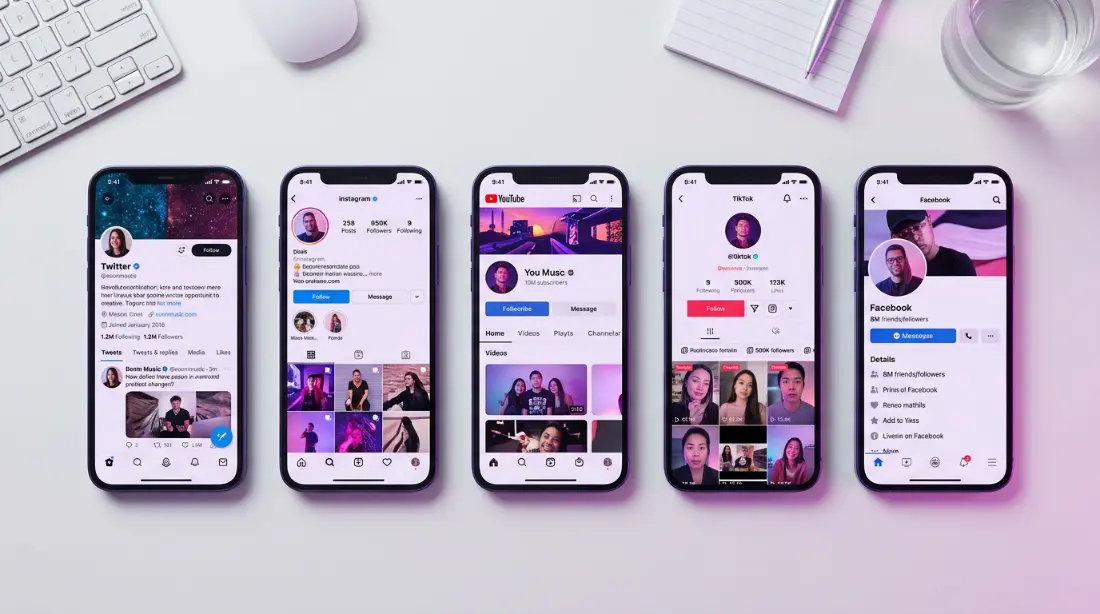
Social proof operates everywhere, but the specific numbers that matter and the thresholds that trigger different responses vary meaningfully by platform.
Twitter / X
Follower count is the dominant signal, but engagement rate is the secondary signal that more sophisticated observers notice. A large follower count with low visible engagement now reads as suspicious to users who've been on the platform long enough. The credibility signal is most powerful when follower count and engagement are in reasonable proportion.
YouTube
View count and subscriber count operate together. A channel with 500 subscribers and videos averaging 50,000 views is trusted differently than a channel with 50,000 subscribers and videos averaging 500 views. The view count per video is actually more important than the subscriber count for content credibility — it shows the audience is real and actively watching.
Follower count remains a strong initial signal, but engagement rate — the ratio of likes and comments to followers — has become more visible and more analysed. The rise of engagement metrics in influencer marketing has made sophisticated observers more attentive to whether follower numbers are matched by genuine activity.
Connection count and endorsements serve social proof functions that are slightly different from pure popularity signals — they're more about professional network legitimacy than audience size. But the underlying mechanism is identical: numerical signals used as quality proxies under uncertainty.
The Cold Start Problem — and Why It's Not Your Fault
If social proof is so powerful, and follower counts influence whether new visitors evaluate your content at all, then accounts starting from zero face a structural disadvantage that has nothing to do with the quality of what they're producing.
The mechanics work against you in the early stages: you don't have followers, so the algorithm doesn't show your content to many people. The few who find you see a low follower count and don't follow, so your count stays low. Which means the algorithm continues not to show your content. The loop is self-reinforcing in the wrong direction.
Breaking this loop organically requires either exceptional content that breaks through despite low social proof — which happens but is relatively rare and unpredictable — or sustained effort over a long enough period that the compounding effect finally starts working in your favour. Most accounts that grow through pure organic effort describe six to twelve months of building in relative obscurity before growth became self-sustaining. Understanding this as structural — not a talent problem — changes the kind of solutions worth considering.
What the Fastest-Growing Accounts Actually Do
The accounts that break through the cold start problem fastest aren't always the ones with the best content. They're the ones most deliberate about building and displaying social proof signals from multiple directions simultaneously.
They Stack Proof Types
Follower count is one signal. Consistent engagement is another. Featured in a well-known publication, even once, is a third. A retweet from a recognised account is a fourth. None of these is sufficient alone. Together they create a profile that reads as legitimate from multiple angles — which makes it much harder for a visitor's unconscious scepticism to find a reason to dismiss you.
They Manage Engagement Ratio Carefully
An account with 5,000 followers that consistently gets 200 likes and 50 retweets is more credible than an account with 50,000 followers that gets the same engagement. Engagement-to-follower ratio is increasingly visible and increasingly read as a quality signal — meaning growing follower count and growing genuine engagement need to happen together.
They Leverage Borrowed Authority
Getting quoted, featured, or engaged with by accounts that already have strong social proof transfers some of that proof to you. This is why consistent, high-quality engagement with larger accounts in your niche is both a visibility strategy and a social proof strategy simultaneously.
And yes — they're often strategic about the baseline credibility signal their follower count provides, particularly in the early stages. Services like GetTwitterRetweet.com exist because the cold start problem is real, and because the social proof deficit it creates has measurable downstream effects on organic growth. That's not manipulation — it's working with the mechanics of how attention and trust actually operate online.
The Reciprocal Relationship Between Social Proof and Content Quality
There's a misconception worth addressing directly: that social proof is a substitute for content quality. It isn't, and treating it as one is the fastest path to building something that collapses.
Social proof is an attention mechanism. It determines whether people give your content a chance. Content quality is the retention mechanism. It determines whether the people who give your content a chance stay, engage, and tell others. A profile with strong social proof and weak content sees high traffic and low conversion. A profile with exceptional content and weak social proof sees low traffic but high conversion among the few who find it. You need both.
This is also why the quality of purchased engagement matters so much. Low-quality followers that inflate your count while suppressing engagement rate are making your content quality problem more visible, not less. They're social proof that undermines itself. High-quality engagement that maintains a credible follower-to-engagement ratio is actually supporting the claim your follower count is making.
Social Proof Beyond Numbers — What Most Profiles Are Missing
Follower count gets most of the attention in conversations about social proof, but it's one of several signals your profile is broadcasting at any given moment.

- Pinned content as proof. Your pinned tweet, video, or post is your permanent first impression. Pinning something that showcases your best work or most impressive result is using your own past performance as social proof. "This piece was seen by 400,000 people" embedded in your profile says something meaningful about whether you're worth following.
- Testimonials and mentions as proof. Screenshots of kind mentions from recognisable people in your niche, real responses to your content that show genuine impact — these work differently from a follower count but often work deeper. They show real people have real responses to your work.
- Consistency as proof. A profile that has been posting quality content in a consistent niche for two or three years is socially proven in a way that a newer profile isn't. The archive itself is evidence. It says: this account has been here, doing this thing, for long enough that it isn't going anywhere.
- Partnership and affiliation signals. Logos of publications you've been featured in, brands you've worked with, events you've spoken at — borrowed social proof that belongs in your bio or header if you have it.
When Numbers Become a Trap
It's worth being honest about the shadow side of social proof optimisation, because it exists and it matters. The pursuit of numbers for their own sake — follower counts, like counts, view counts divorced from any underlying purpose — is one of the more effective ways to build an online presence that looks impressive and delivers nothing.
Follower count is a proxy for influence and reach. When you optimise for follower count as an end in itself, you can get the number without the thing the number was pointing toward. Engagement rate drops. The audience doesn't convert to anything real. The social proof signals start to contradict each other — large following, minimal engagement, no visible impact.
Use social proof as a means to an end: getting your content in front of more people, building the credibility that allows your expertise to be heard, creating the conditions where genuine audience growth becomes self-sustaining. The number is in service of something. When the number becomes the goal, the something disappears. The most effective creators treat social proof metrics the way a good businessperson treats revenue — an important signal to track and manage, but never the point of the exercise itself.
FAQ: Social Proof and Social Media Growth
The Practical Takeaway for Your Profile Right Now
The numbers on your profile are being read as evidence before your content is evaluated. This is happening whether you're managing those numbers deliberately or not. The only question is whether those numbers are working for you or against you.
If you're below the credibility floor — the threshold where social proof starts reducing friction rather than creating it — that's the most important problem to solve. Not by ignoring content quality, but by recognising that content quality alone can't solve a social proof deficit in any reasonable timeframe organically.
Stack the types of social proof available to you. Your numbers. Your testimonials. Your consistency archive. Your affiliations. Your pinned content. Any single signal is easy to discount. Multiple converging signals are much harder to dismiss. The queue outside the restaurant wasn't an accident. The smart restaurants figured out how to build one. The social media accounts you're watching grow fastest have figured out the same thing.
Ready to Build Your Social Proof Foundation?
GetTwitterRetweet.com provides high-quality engagement services across every major platform — helping you clear the credibility floor while your organic strategy builds the audience that sustains growth long term.
Build Credibility Across Every Platform
Every signal that helps your profile pass the first-pass filter and get evaluated on its actual merits