Organic Growth vs. Buying Engagement: What's the Right Mix?
The social media growth conversation has two camps, and both of them are wrong in approximately equal measure.
Organic Only. Authenticity Above All.
Buying engagement is cheating, it doesn't work, it undermines the platform ecosystem. They say this from carefully curated accounts with slowly growing followings, posting thoughtful content into a void while the algorithm quietly punishes them for not already having the traction the algorithm requires before it gives you traction.
Buy Everything. Numbers Are Numbers.
Social proof is social proof. The platforms are rigged toward established accounts anyway. They say this while buying low-quality followers in bulk, watching their engagement rate collapse, getting accounts flagged, and wondering why the strategy that worked for someone's case study isn't working for them.
It exists in the specific, thoughtful combination of both approaches, applied in the right proportion, at the right stage of growth, for the right reasons. This guide is not a defence of buying engagement and not a defence of organic purity. It's an honest, practical examination of what each approach actually does, where each one fails without the other, and how to determine the right mix for your specific situation.
Why the Binary Framing Is the Problem

Start with the assumption embedded in "organic growth." The word organic implies natural, unforced, arising spontaneously from genuine quality. But organic social media growth in 2026 is not natural in any meaningful sense. It involves deliberate hook optimisation, strategic posting times, format testing, hashtag research, algorithm reverse-engineering, and a sustained effort to understand and exploit platform mechanics. This is sophisticated strategy, not spontaneous emergence. The "organic" label describes the absence of paid engagement, not the absence of strategic manipulation.
Now consider what "buying engagement" actually involves in practice. At the high-quality end — gradual delivery, real-looking accounts, proportional volumes, from reputable services — purchased followers and engagement are a social proof tool used to solve a specific structural problem: the cold start disadvantage that prevents new accounts from getting the algorithmic distribution their content deserves. At the low-quality end — bulk bot followers, overnight delivery spikes, obviously artificial engagement patterns — purchased engagement is a shortcut that damages account health while providing only the illusion of the thing it's supposed to deliver.
It's "what specific problem am I trying to solve, and what combination of approaches solves it without creating a worse problem downstream?" That's a different question, and it has a specific answer that depends on where you are, what you're building, and what your timeline is. Conflating the two ends of the quality spectrum under the same label, and then arguing about whether the category is good or bad, is the reason the conversation produces so little light.
What Organic Growth Actually Does — and Where It Breaks Down
Organic growth, executed well, is the most durable form of social media audience development available. The followers you earn through content quality, genuine engagement, and community building are followers who actually want to be there. They watch your content. They reply to your posts. They tell other people about your account. They convert into customers, subscribers, or advocates at a rate that purchased followers cannot match. This is not in dispute. The organic case is real and the people who make it are not wrong about what organic growth produces when it works.
The problem is the "when it works" clause. Because organic growth, without the algorithmic conditions that allow it to compound, doesn't work the way its advocates describe. It works as a theory. It stalls as a practice.
Every major platform uses an engagement-based distribution algorithm. New accounts have no historical performance data. The algorithm defaults to conservative distribution — a small test audience. If that audience generates strong early engagement, the algorithm expands. If it doesn't — because the test audience is too small to generate meaningful engagement signals even from excellent content — the algorithm keeps distribution narrow. The content sits in a box where nobody sees it, generating no engagement, giving the algorithm no new data to work with. This is not a temporary inconvenience. It's a structural disadvantage built into how every major platform's distribution system works. Organic growth strategy, no matter how sophisticated, cannot fully overcome it when starting conditions are this unfavourable.
What Buying Engagement Actually Does — and Where It Breaks Down
Purchased engagement, applied correctly, solves specific problems that organic strategy cannot solve on its own during the early stages of account growth.
What It Does Well
The social proof problem is real. When a potential follower visits your profile and sees a follower count in the low double digits with single-digit likes per post, they're processing environmental signals that suggest this account hasn't been validated by other people. Low numbers suggest low value — not because your potential audience is shallow, but because using visible signals to filter attention under conditions of information scarcity is rational behaviour. Purchasing a credible baseline of followers and engagement addresses this specific problem directly.
The algorithmic signal problem is also real. Purchased followers provide a larger initial test audience for new content — which means first-hour engagement numbers are higher in absolute terms, which means the algorithm has a clearer signal that the content is worth distributing further. This is not about gaming the algorithm. It's about providing enough initial data for the algorithm to evaluate the content accurately.
Where It Breaks Down
Purchased engagement doesn't solve a content quality problem. An account buying followers onto content that genuinely doesn't resonate is buying visibility into a void — the follower count goes up, the engagement rate collapses because the followers aren't real participants. It doesn't solve an audience alignment problem. And at the low-quality end of the service market, it doesn't even reliably deliver on its own promises — bulk bot followers dropped overnight spike the count artificially, get swept in platform purges within weeks, and leave behind a damaged engagement rate that's worse than the original problem.
The Cold Start Framework — When Each Approach Applies
The most useful way to think about the organic-versus-purchased question is through a cold start framework — a model that recognises the structural reality that different approaches serve different purposes at different growth stages.
Zero to Credible Presence
The period from account creation to the point where your follower count, engagement baseline, and posting history are sufficient to pass the initial social proof filter most visitors unconsciously apply. Organic strategy produces genuine quality benefits too slowly to solve the social proof problem within a competitive timeline. This is where strategic use of purchased followers serves its clearest function: establishing the credibility baseline that allows the organic work to be evaluated on its merits.
60–70% purchased / 30–40% organicCredible Presence to Genuine Community
Your account has established enough social proof to be taken seriously. The work is building the engaged audience that transforms a follower count into a real community. Organic strategy becomes the dominant approach — and must become the dominant approach, because purchased engagement doesn't build community. Real replies, real conversations, real content resonance are the inputs that produce the community quality that makes a social media presence genuinely valuable.
80–90% organic / 10–20% purchasedGenuine Community to Influence and Monetisation
Organic strategy is the engine and purchased engagement is at most an occasional amplification tool for specific high-value content. An established account amplifying a product launch or an important piece of content with a targeted boost is using purchased engagement as a precision tool, not a crutch. The organic foundation is doing the real work.
95%+ organic / surgical purchased use onlyThe Quality Variable That Changes Everything
The "right mix" conversation is incomplete without addressing the most important variable in the entire equation: the quality of the purchased engagement. This is where most horror stories about buying social media engagement originate, and where the blanket dismissal of the practice gets its most legitimate ammunition.
Bulk followers from obvious bot accounts delivered overnight, views from IP farms with no geographic distribution, likes from accounts with no posting history and generic usernames. Doesn't just fail to deliver the benefits described — it actively damages the account. Engagement rate collapses. Algorithmic signal is negative because the acquisition pattern looks nothing like organic growth. Social proof signal becomes incoherent to sophisticated observers. Platform detection systems flag the anomalous pattern and take action. The cheap option is not a discount on the right option — it's a different product that produces a different, usually bad, outcome.
Gradual delivery from real-looking accounts with activity history and geographic diversity, at volumes proportional to the account's organic baseline, from services that offer retention guarantees and transparent delivery practices. Provides the social proof signal that actually works. Delivery pattern looks like organic growth acceleration rather than artificial inflation. Account's engagement rate isn't damaged because volume is calibrated to actual organic engagement level. Platform detection systems are less likely to flag what looks like a moderately successful content week rather than an obvious manipulation event.
GetTwitterRetweet.com operates in the high-quality tier because the business model depends on delivering engagement that actually works — that survives platform purges, maintains accounts' engagement health, and produces the social proof and algorithmic benefits that give clients reasons to return. A service selling engagement that gets immediately removed and damages account health doesn't build a sustainable customer base. The practical implication: the price differential between low-quality and high-quality services is real, and choosing based primarily on cost produces results that confirm the skeptics' worst assumptions about what purchased engagement does.
The Content Foundation That Makes the Mix Work
The right mix of organic and purchased engagement only produces results when the content foundation underneath it is solid. Purchased engagement is not a content strategy. It's a distribution and social proof tool applied on top of a content strategy.
An account with excellent social proof numbers and genuinely poor content will see the following pattern: visitors arrive because the numbers look credible, they evaluate the content, they don't find enough value to follow or engage, they leave. The purchased engagement bought you the evaluation. The content quality determines whether you pass it.
Look honestly at your most recent ten pieces of content and ask whether someone would save it, share it, or come back to see more. If the answer is consistently no, the content strategy is the primary problem — and purchased engagement applied to it is deferred disappointment rather than accelerated growth. If the answer is consistently yes — if the content genuinely delivers, if it's the kind of thing that would grow if more people saw it — then the case for purchased engagement as a distribution accelerator is legitimate. You're not manufacturing the appearance of value. You're giving genuine value the initial signal it needs to get distribution from a platform that won't distribute it otherwise.
Platform-Specific Mix Considerations
The right ratio also varies meaningfully between platforms because each platform's algorithm weighs different signals differently, each platform's social proof thresholds are different, and each platform's detection systems have different sensitivity levels.
| Platform | Key Social Proof Signal | What Organic Must Do | What Purchased Can Address |
|---|---|---|---|
| Twitter / X | Follower count — prerequisite for being perceived as a credible voice in any conversation | Tweet quality, hook strength, engagement with established accounts in your niche | Follower baseline that establishes credibility as a legitimate participant |
| Multi-dimensional: follower count, post likes, Story view rates, profile aesthetic coherence | Save-and-share-worthy content that generates the algorithmic signals the current algorithm weights most | Follower count and like count social proof dimensions while organic drives saves and shares | |
| YouTube | Watch hours and subscriber count — the two monetisation threshold metrics | Content that earns genuine watch time: compelling hooks, strong retention, satisfying conclusions | Watch hours for monetisation threshold specifically; subscribers who don't watch don't contribute to any meaningful signal |
| Follower count, connection quality, visible engagement from recognisable professional titles | Thought leadership content that generates substantive professional engagement and comment quality | Institutional credibility baseline that makes organic content land differently with professional audiences | |
| TikTok | Follower count for social proof and monetisation thresholds; video views for content distribution | Completion rate and share-worthy content; views are the primary distribution signal not follower count | View-level services have more direct algorithmic impact on TikTok than follower purchases alone |
The Engagement Rate Ceiling — When Buying More Stops Helping
There's a specific point in the organic-purchased mix where adding more purchased engagement starts producing diminishing returns — and then negative returns. Understanding where that ceiling is prevents a common mistake that damages accounts that were otherwise making the right decisions.
Every account has an organic engagement rate — the percentage of its real, active followers who engage with any given piece of content. When purchased followers inflate your total follower count significantly above what your organic engagement can cover, your visible engagement rate drops to a level that looks suspicious. An account with fifty thousand followers averaging thirty likes and two comments per post is flying a flag that its follower count is not what it appears to be.
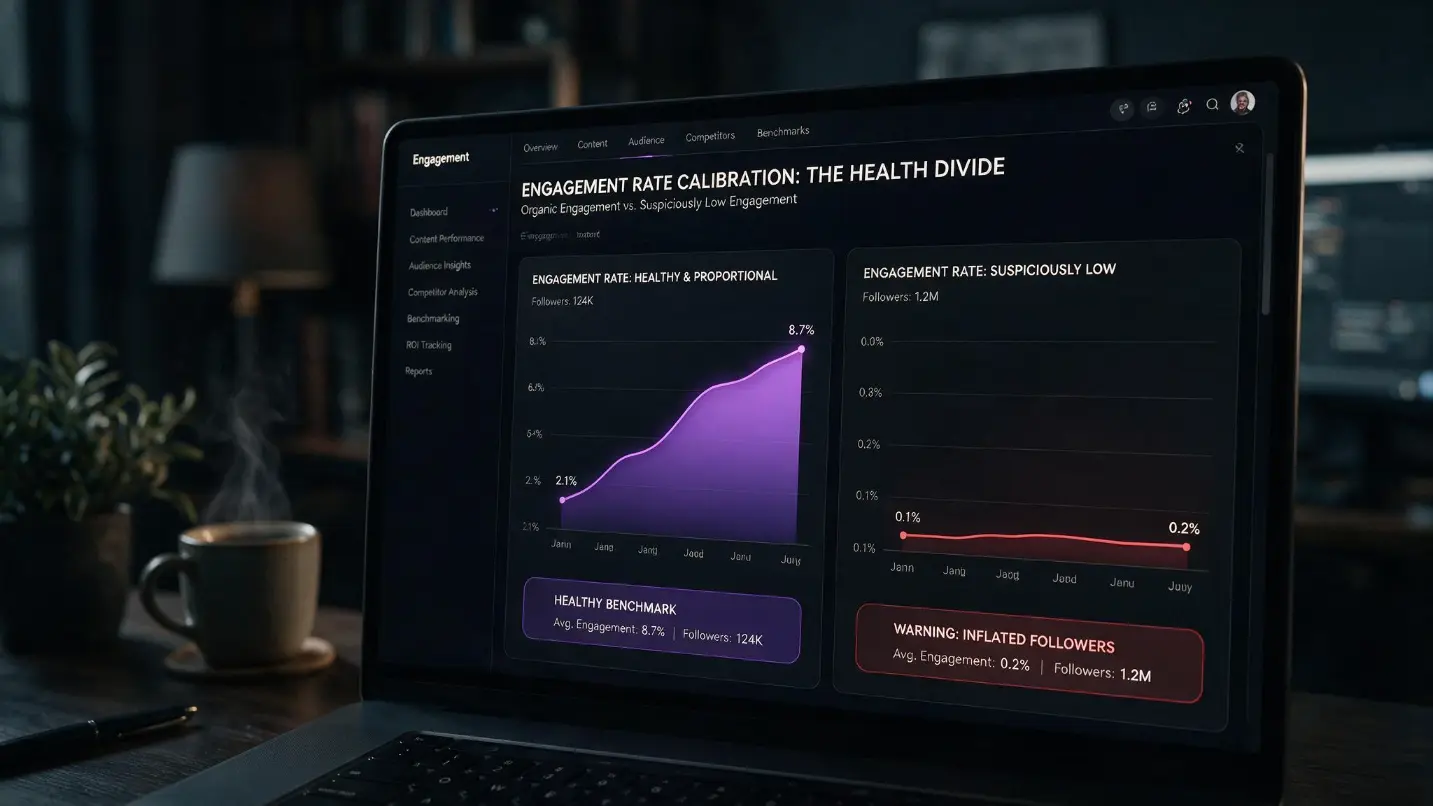
Before any purchased follower addition, calculate your current organic engagement rate and estimate what your rate would look like at the new follower count you're considering. If the projected rate falls significantly below the industry benchmark for your account size and category — typically 1–3% for accounts in the 10K–100K follower range — the proposed addition is too large relative to your organic engagement baseline. Scale back the purchase, focus on growing genuine engagement through content quality, and revisit the purchased follower addition when your organic baseline can support a higher follower count credibly.
What Compound Growth Actually Looks Like Over Time
The accounts that have genuinely built something over a two to three year horizon — large, engaged audiences and real influence in their niches — almost universally followed some version of the pattern this guide describes, whether they framed it that way or not. They invested in the social proof infrastructure that got them past the initial credibility threshold. They invested in content quality that made their profile worth following. They built engagement habits that developed real community with the real followers who arrived and stayed. They used acceleration tools strategically and proportionally rather than as a crutch.
Organic followers generate engagement that feeds algorithmic distribution. Better distribution brings more organic followers. More followers make the social proof stronger, which converts profile visitors to followers at a higher rate. More high-quality followers generate more high-quality engagement. The algorithm distributes further. Each cycle amplifies the previous one. Purchased followers are the starter coil — the input that gets the flywheel moving when organic friction is too high to start it alone. Once it's spinning, organic inputs take over as the primary fuel. The accounts that never phase out purchased engagement — that continue relying on it as a primary input even after organic compounding should be taking over — are the accounts that have a different problem. The content isn't converting organic visitors to genuine followers, and purchased engagement is masking the problem rather than solving it.
The Honest Answer to the Mix Question
The right mix of organic growth and purchased engagement is the one that solves your specific problem at your specific stage with your specific content foundation. That's not an evasion — it's the only answer that's actually true.
- Cold start phase with genuine content quality: meaningful investment in purchased social proof to establish the credibility baseline, combined with full investment in organic content quality and community engagement. The mix skews purchased early and organic as the dominant input once the flywheel starts.
- Credible follower count but declining engagement: almost entirely organic. The problem isn't social proof — it's content alignment, posting consistency, or audience relationship depth. Purchased engagement applied to this problem treats a symptom while the cause gets worse.
- Preparing for a specific commercial moment — a product launch, a campaign, a pitch for brand partnerships: targeted purchased engagement on specific content combined with genuine organic activation of the real community that will make the commercial moment actually successful.
- Genuinely growing organically and wondering whether to add purchased engagement: probably not unless there's a specific gap it would address. Organic momentum that's already working doesn't need the cold start intervention that purchased engagement is best at providing.
FAQ: Organic Growth vs. Buying Engagement
The Right Mix Is What You Find at the End of Honest Answers

The question is never organic or purchased. The question is always what problem you're solving, what stage you're in, and whether the proposed tool actually addresses the problem or just changes which number you're watching while the real issue continues.
For an account in the cold start phase with genuine content quality: use both, with purchased as the early social proof foundation and organic as the compounding engine that takes over once the flywheel starts. For an account with content alignment or engagement problems: fix the organic strategy first — purchased engagement applied to a broken organic foundation is deferred disappointment. For any account at any stage: the content foundation is the non-negotiable. Purchased engagement buys you the evaluation. Content quality determines whether you pass it. Answer those questions honestly for your specific situation. The right mix is what you find at the end of that honest answer.
Ready to Add High-Quality Purchased Engagement to Your Growth Mix?
GetTwitterRetweet.com delivers across Twitter, Instagram, YouTube, TikTok, LinkedIn, and more — gradual delivery, quality accounts, transparent methodology, and retention guarantees that make purchased engagement a genuine growth tool rather than a number that disappears in the next platform sweep.
The Right Purchased Engagement, Applied at the Right Stage
Quality delivery across every platform — calibrated to your organic baseline so the purchased input actually serves your growth rather than undermining it