How to Get Views on YouTube Organically — Strategies That Actually Work
You uploaded your best video yet. The editing is tight, the content is solid, and you hit publish with real excitement. Then — silence. A handful of views from your immediate circle, and then nothing.
Sound familiar? With over 500 hours of video uploaded to YouTube every minute, standing out isn't just about quality — it's about strategy. The creators who grow aren't necessarily the most talented. They're the ones who understand how YouTube's algorithm actually works.
No shortcuts, no gimmicks. The real strategies that consistently move the needle for organic YouTube growth in 2026 — from keyword research before you hit record to reading analytics after every upload.
Nail Your YouTube SEO Before You Even Hit Record
YouTube is the world's second-largest search engine. People are actively searching for videos like yours every day — you just need to make sure your content shows up when they do.
Keyword Research First, Content Second
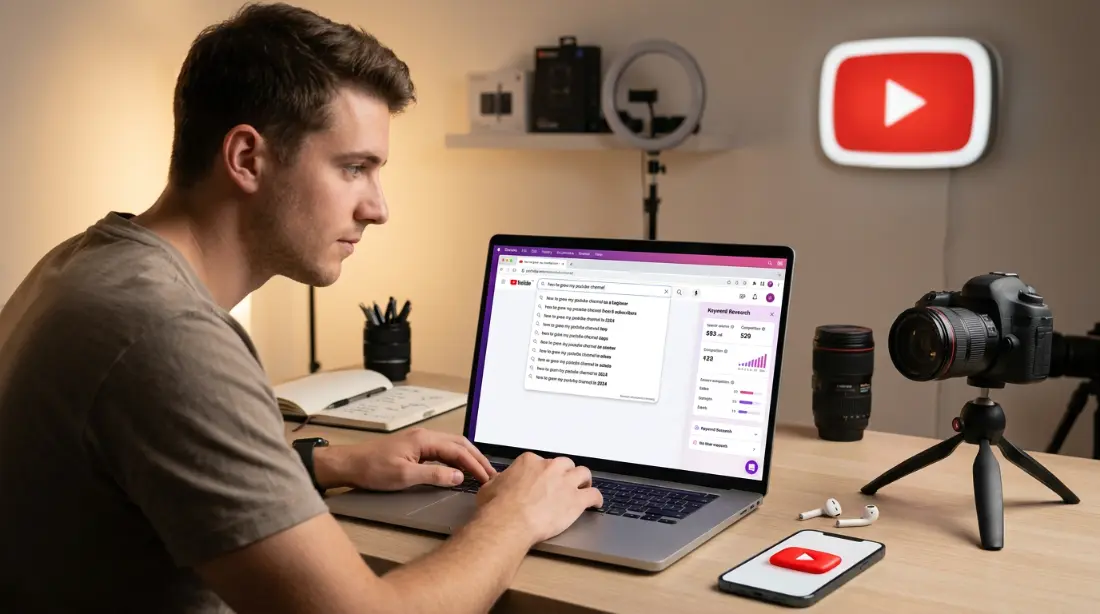
Before you start scripting, spend 20 minutes on keyword research. Tools like TubeBuddy, VidIQ, or even YouTube's own search autocomplete reveal what people are actually looking for in your niche. Type your topic into YouTube's search bar and study the autocomplete suggestions — these are real searches real people make every day. Focus on long-tail keywords (three to five words) — they're easier to rank for and attract more targeted viewers who are likely to watch longer.
Put Your Keyword in the Right Places
Once you have your target keyword, use it naturally in your video title (ideally within the first five words), the first 100 words of your description, three to five relevant tags, your video file name before uploading, and spoken naturally in the video itself — YouTube's auto-captions pick this up as a ranking signal.
Write at least 250 words in your description. Weave in your keyword two to three times naturally, and link to related videos and playlists on your channel. YouTube reads descriptions like a search crawler — most creators write three sentences and leave significant ranking potential on the table.
Thumbnails Are Your Most Powerful Organic Growth Tool
90% of the best-performing videos on YouTube use custom thumbnails. Your thumbnail is your billboard — it's the difference between someone clicking or scrolling straight past you.
- High contrast — bold colours that pop against YouTube's white or dark background
- A clear focal point — usually a face with a strong expression, or a single obvious subject
- Minimal text — three to five words maximum, large enough to read on a phone screen
- Curiosity or benefit — the viewer should immediately think "I need to watch this"
Shrink your thumbnail to 120×90px — the size it appears in YouTube search results on mobile. If it looks unclear or cluttered at that size, redesign before publishing. Tools like Canva make this simple even without graphic design experience. Your thumbnail deserves as much time as your video's opening thirty seconds.
The First 48 Hours Matter More Than You Think
YouTube's algorithm pays close attention to how a video performs in its first 48 hours. Strong early engagement signals that the algorithm should push your video to a wider audience — and weak early performance buries it before it ever gets a real chance.
Step 1Post at peak times
For most channels, Thursday through Saturday afternoons in your audience's timezone perform best. Check your YouTube Analytics audience activity data once you have enough history to confirm your specific peak windows.
Step 2Notify your community
Use YouTube's Community tab to tease new uploads before they go live. A post the day before that hints at what's coming primes your existing subscribers to watch as soon as it drops.
Step 3Share in relevant communities
Reddit threads, Facebook Groups, Discord servers — but only where it adds genuine value. A link drop in an irrelevant thread gets flagged as spam and drives no meaningful traffic. Contextual, value-adding sharing works. Cold link dumping doesn't.
Step 4Email your list
If you have a newsletter or email list, this is the single fastest way to spike early views. Even a small list of a few hundred engaged subscribers can generate the early engagement signal that shifts the algorithm's decision from "limited push" to "expand distribution."
Understand the Algorithm — Without Trying to Game It
The algorithm isn't your enemy. It's designed to help great content find an audience. Understanding what it rewards helps you create more of what works.
Click-through rate (CTR) measures how often people click your video when shown it. Below 3%? Fix your thumbnail and title first — everything else is secondary until that number improves. Average view duration is how long people actually watch. YouTube prioritises videos that keep people on the platform. Engagement rate — likes, comments, shares, and saves — tells the algorithm your content creates a genuine reaction worth distributing further.
Skip the long animated intros and slow logo reveals — viewers click away within seconds. Get to the value immediately: a bold statement, a surprising statistic, or a quick preview of exactly what viewers will get from watching. New viewer attention is borrowed. You earn the slow intro after someone trusts your channel.
Build a Content Strategy Around Playlists
Playlists are one of YouTube's most underused organic growth tools. When a viewer finishes one video and the next auto-plays, your watch time compounds — and the algorithm notices. Organise your content into three to five focused playlists around your main topics.
When one video ranks for a keyword, it can pull viewers into a playlist where they watch three or four more — a massive signal to YouTube that your channel deserves more reach. A single well-performing video can become the entry point for hours of watch time if the playlist behind it is well-structured and thematically coherent.
Consistency Beats Perfection Every Single Time
The biggest mistake new creators make is spending three weeks perfecting a single video instead of publishing consistently. YouTube rewards channels that show up regularly — both algorithmically and in terms of subscriber behaviour.
You don't need to post daily. You need a schedule you can actually keep. Whether that's once a week or twice a month, consistency signals to YouTube and your subscribers that you're a reliable creator worth following.
The channels that grow aren't always the ones with the best production quality. They're the ones that showed up consistently for twelve months when everyone else quit. The creators who quit at video twenty will never know what they could have achieved at video sixty. Set a publishing schedule you can maintain and protect it like it's the most important part of your strategy — because it is.
Collaborate and Cross-Promote
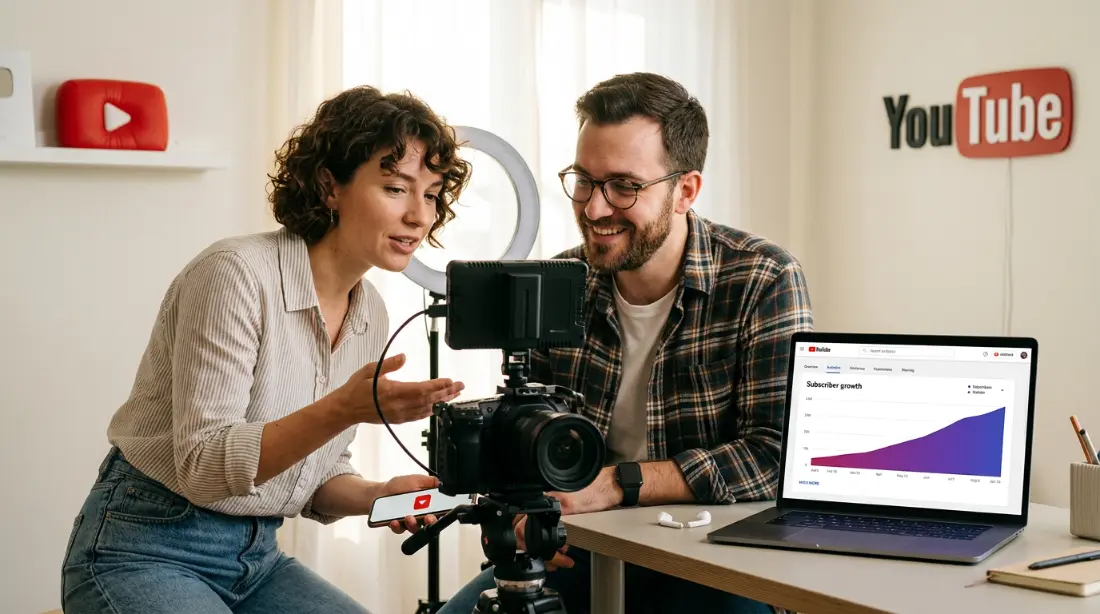
One of the fastest organic growth strategies is getting your content in front of someone else's audience. Collaboration doesn't have to mean expensive travel or elaborate co-productions.
- Comment on bigger channels in your niche — thoughtful, value-adding comments drive curious viewers to your channel. Generic "great video!" comments achieve nothing.
- Guest appearances — offer to be interviewed on channels slightly larger than yours. You get exposure to their audience; they get content. Mutual benefit.
- Shoutout exchanges — find channels at a similar size in a complementary (not competing) niche and genuinely recommend each other.
- Feature other creators — reaction videos, response videos, and collaborative lists all open doors to new audiences and often result in reciprocal exposure.
Drive YouTube Views From Other Platforms
Organic YouTube growth doesn't have to happen only on YouTube. Every piece of content you create can funnel viewers from other platforms.
- Instagram Reels and TikTok — post 30–60 second clips from your YouTube videos with a clear call to action to watch the full video
- Twitter / X — share key insights or a quote from your video with a link. Opinion-driven tweet threads built around your video topic drive significant click-through.
- Pinterest — hugely underrated as a YouTube traffic source. Create pins linking to your videos; Pinterest has long content shelf life that keeps driving traffic for months.
- Your website or blog — embed your YouTube videos in relevant posts to drive views and boost time-on-site simultaneously.
Use Analytics to Double Down on What's Working
YouTube Studio's analytics are a goldmine most creators barely touch. The view count is just the surface — the real insights are deeper.
Traffic sources — are views coming from YouTube Search, Suggested, or External? Double down on whichever channel is already working for you.
Audience retention graph — look for the exact timestamps where viewers drop off. Identify the pattern and fix it in future videos. The drop-off point is the most actionable data YouTube gives you.
Impressions vs. CTR — lots of impressions but low CTR means your thumbnail and title need work. Good CTR but low watch time means your content isn't delivering on its promise.
Returning vs. new viewers — a healthy channel grows its percentage of returning viewers over time. This signals you're building a real community, not just collecting random one-off clicks.
Check analytics after every video — not to obsess over numbers, but to identify the one thing each video teaches you about what your specific audience responds to. Over months, that iterative learning compounds into a deep understanding of your niche that no competitor can replicate quickly.
FAQ: Getting Views on YouTube Organically
Final Thoughts — Organic Growth Is a Process, Not a Hack
Getting views on YouTube organically takes time. Most channels see their first real breakthrough somewhere between video fifty and video one hundred — not because YouTube is broken, but because the algorithm needs enough signal to understand your content and your audience before it starts working for you.
The strategies above — keyword-driven SEO, compelling thumbnails, strong retention hooks, consistent publishing, and smart cross-platform promotion — are what separate growing channels from stagnating ones. Start with two or three of these tactics this week. Measure your results. Iterate.
Organic YouTube growth rewards consistency, quality, and patience. Show up regularly, optimise intelligently, engage your community — and the algorithm will eventually work in your favour. Every video you publish teaches you something new. Every analytics report shows you what your audience responds to. The creators who quit at video twenty will never know what they could have achieved at video sixty. The algorithm is waiting for you to show up consistently.
Want to Accelerate Your YouTube Growth?
Give your best videos the early momentum they need. GetTwitterRetweet.com's YouTube services help quality content clear the initial distribution threshold faster.
Complete Your YouTube Growth Strategy
Every engagement signal that helps your content get recommended and your channel taken seriously