How to Grow Multiple Social Media Accounts at the Same Time (Without Burning Out)
At some point, the spreadsheet appears. A tab for Instagram posting schedule. Another for Twitter content ideas. A third for YouTube upload dates. Maybe a fourth for LinkedIn that you added during a moment of professional ambition and have since stopped updating. The spreadsheet grows. The colour coding becomes elaborate. The tabs multiply. And somewhere between the content calendar and the engagement tracking columns, a quiet panic sets in.
You're supposed to be growing five platforms. You're actually posting consistently to one, occasionally to two, and guiltily ignoring the rest while they sit at follower counts that haven't moved in three months.
They've built systems, made specific choices about prioritisation, and developed an approach to content that lets them operate across multiple platforms without the energy cost scaling linearly with the number of platforms. This guide breaks down exactly what that looks like — the mental models, the practical systems, the platform-specific considerations, and the honest conversation about what multi-platform growth actually requires.
The Mistake That Kills Multi-Platform Growth Before It Starts

The default approach is treating every platform as a separate content creation obligation. Instagram needs content. Twitter needs content. YouTube needs content. LinkedIn needs content. TikTok needs content. Each platform is a bucket that needs filling, and filling five buckets requires five times the content creation effort of filling one.
Run this approach for three weeks and something predictable happens. Content quality drops because you're producing too much too fast. Consistency drops because the workload isn't sustainable. Strategic thinking evaporates because you're spending all cognitive energy on execution. The accounts that were growing start stagnating because the content has become mechanical. You end up with five mediocre presences rather than one strong one.
Build a content ecosystem rather than manage a content assembly line. In an ecosystem, content flows between platforms through deliberate repurposing and adaptation rather than being created from scratch for each destination. Energy invested in one piece of content generates value across multiple platforms rather than being consumed by a single post and discarded. This reframe — from content production to content architecture — is the conceptual shift that makes multi-platform growth achievable rather than just exhausting.
The Platform Hierarchy — The Decision Most People Skip
Platform hierarchy means explicitly deciding which platform is your primary — where your best content lives first, where your most significant creative investment goes, where your most important audience relationship is being built — and which platforms are secondary, receiving adapted versions of your primary content as their main input.
Treating all platforms as equally important is a decision that guarantees mediocrity everywhere, because it prevents the focused attention that any single platform needs to generate meaningful momentum.
The criteria: where your target audience actually spends time, which platform's content format suits what you're genuinely best at making, which platform is currently offering the most favourable organic reach for your content category, and which platform aligns most directly with your actual business or personal brand goals. A business selling professional services to corporate clients probably has LinkedIn as primary with Twitter as secondary. A fitness creator probably has Instagram or TikTok as primary with YouTube as secondary. The hierarchy is always specific to the creator and the goal — not derived from which platforms are most popular in the abstract.
Once the hierarchy is clear, multi-platform management becomes a much more organised problem. Your primary platform gets the full creative process. Your secondary platforms get intelligent adaptation of what you're already creating. This is not a permanent decision — your hierarchy can evolve as platforms change and as you discover which ones are actually driving results — but operating without a hierarchy is operating without priorities.
The Content Pillar System — How One Idea Becomes Many
A content pillar is a substantial idea, topic, or insight that lives at a level of abstraction above any single post. Not a tweet. Not a caption. A concept worth exploring from multiple angles, in multiple formats, for multiple audiences. "Why engagement rate matters more than follower count for business outcomes" is a content pillar. "The psychological reason most people quit social media before it starts working" is a content pillar.
Content Pillar: One Substantial Idea
e.g. "Why engagement rate matters more than follower count for business outcomes"
Long-Form Video
Full topic explored in depth with examples, context, and nuance
Thread
Key argument distilled into a shareable, scannable sequence
Carousel
Concept broken into visual steps or framework elements
Professional Post
Insight framed in terms of professional application and business context
Short Video
Most counterintuitive or emotionally resonant moment — immediate hook
Content that works on LinkedIn fails on TikTok not because the idea is wrong for TikTok but because the presentation, pacing, tone, and structure that works in a professional text environment doesn't translate directly into a sixty-second video format. A creator who copies the same caption unchanged across five platforms is not doing cross-platform content strategy. They're doing cross-platform content spam, and every platform's audience recognises it immediately and responds with lower engagement. Genuine adaptation — even when it requires additional formatting work — produces dramatically better results.
Platform-Specific Adaptation — What Changes and What Stays
What stays consistent: the core insight, the underlying argument, the factual content, your brand voice at the fundamental level, and the genuine value being delivered. These are the platform-agnostic elements — the substance that makes the content worth encountering regardless of where it appears.
What changes: format and structure, length and pacing, tone calibration, the specific hook that opens the content, visual presentation, and the type of engagement call to action appropriate for each platform's culture.
| Platform | Primary Demand | The Specific Adaptation Required |
|---|---|---|
| Twitter / X | Aggressive compression | The most essential, most surprising, or most polarising element of the idea. Hook in under fifteen words. Immediate payoff. Twitter has no patience for build-up and no tolerance for unnecessary context. |
| Visual hierarchy | Before the caption is read, the image or video needs to stop the scroll. The caption provides depth after the visual earns the attention, but caption is secondary to image in a way that's reversed on Twitter or LinkedIn. | |
| Professional relevance | The same insight needs reframing in terms of professional application and business outcome. The humour can stay — LinkedIn audiences respond to genuine personality — but the framing must connect to professional stakes that LinkedIn's audience cares about. | |
| TikTok | Immediate hook, retention | Compelling within the first two seconds. Strong retention through motion, pacing, and narrative momentum. The concept that works as a static carousel needs energy, visual dynamism, and a reason to keep watching when adapted for TikTok. |
| YouTube | Depth and expansion | The same idea that needs ruthless compression for Twitter can be expanded, contextualised, illustrated with examples, and explored from multiple angles. The audience opted in to longer format. Use it. |
The Weekly Workflow That Makes This Sustainable
Understanding the content pillar system conceptually is one thing. Building a workflow that executes it consistently without consuming your entire life is the practical challenge. The workflow sustainable multi-platform creators describe most consistently has a batching logic: create at the primary level first, then adapt downward through the hierarchy, then schedule everything in advance so execution doesn't require daily decisions.
Develop This Week's Content Pillar
Write the long-form Twitter thread or record the YouTube video — whichever represents your primary platform output. This is your deepest creative investment and it generates the source material for everything else. All cognitive energy goes here. The thinking is done once and flows forward.
Produce Platform Adaptations
The Twitter thread gets reformatted as an Instagram carousel. The YouTube video gets clipped for TikTok. The core argument gets reframed as a LinkedIn post. The most interesting single point becomes a standalone tweet. You're not creating new ideas — you're translating existing ones. Cognitive load is substantially lower because the thinking is already done.
Schedule Everything
Everything goes into your scheduling tool for the week. The week's posting obligations are complete on Wednesday. No more daily content decisions. No more last-minute scrambling for something to post. The execution is handled.
Engagement, Community & Next Week's Ideas
All remaining time goes to genuine engagement on your primary platform, community building on secondary platforms, and developing next week's pillar idea. Total weekly content creation time for this workflow once established: typically 6–10 hours rather than the 15–20 hours daily fresh-content creation across five platforms would require.
The Tools That Actually Help — and the Ones That Don't
Multi-platform social media management has generated a massive ecosystem of tools — and the honest reality is that most creators use too many of them, which creates its own management overhead. The tools worth using fall into three categories.
- Scheduling and queue management: Buffer works well for accounts primarily posting text and image content across Twitter, LinkedIn, and Instagram. Later is specifically strong for Instagram and TikTok visual content planning. Hootsuite handles more complex multi-account setups and is particularly useful for teams. Pick one that fits your primary platform mix. The mistake is subscribing to all three.
- Content creation and adaptation: Canva handles the visual adaptation workflow for most creators without requiring design expertise. Creating a master content design template with size variants for each platform — Twitter's 16:9, Instagram's 1:1 square and 4:5 portrait, LinkedIn's landscape format — means adapting a piece of content across platforms is a resize and minor layout adjustment rather than a full design exercise.
- Analytics: Native analytics dashboards within each platform remain the most reliable source for platform-specific performance data. A simple spreadsheet tracking key metrics for each platform weekly is often more useful than an elaborate third-party dashboard — less impressive visually, more reliably accurate.
Complex social media management platforms with steep learning curves, AI content generation tools that produce platform-inappropriate content requiring significant editing before use, and notification aggregators that consolidate engagement notifications from multiple platforms into a single stream. The last category specifically sounds like a time-saver and usually becomes an attention fragmentation trap — ambient awareness of every platform simultaneously rather than focused presence on any one of them.
The Engagement Problem — How to Be Present Across Multiple Platforms
Content posting is only half of social media growth. The other half — the half that most multi-platform management advice conveniently underemphasises — is engagement. Responding to comments. Participating in conversations. Building the relationships that create community rather than just audience.
You cannot be genuinely present in five places at the same time. The quality of engagement that builds real community requires actual attention — reading what someone wrote, thinking about it, and responding in a way that's specific to their comment rather than generic. Spreading this attention across five active platforms produces five platforms full of surface-level responses that satisfy nobody and build nothing.
Your primary platform gets your highest-quality, most consistent engagement attention — thoughtful responses, genuine conversation participation, specific relationship building. Your secondary platforms get more efficient, less intensive engagement: responses to direct questions, acknowledgement of substantive comments, participation in high-visibility conversations directly related to your content. Time-block your engagement rather than leaving notifications open all day. Thirty minutes on your primary platform in the morning. Twenty minutes across secondary platforms in the evening. Notifications off between blocks. This structure produces better engagement quality and lower mental overhead than ambient notification-checking.
The Cross-Platform Promotion Flywheel
One of the genuine multiplier effects of managing multiple accounts intelligently is the ability to use each platform's audience to feed growth on the others — a flywheel effect unavailable to single-platform creators. Your Twitter audience contains people who would watch your YouTube videos if they knew those videos existed. Your Instagram audience contains potential LinkedIn connections who don't know your professional work. Your TikTok audience contains people who would join your email list if given a direct path.
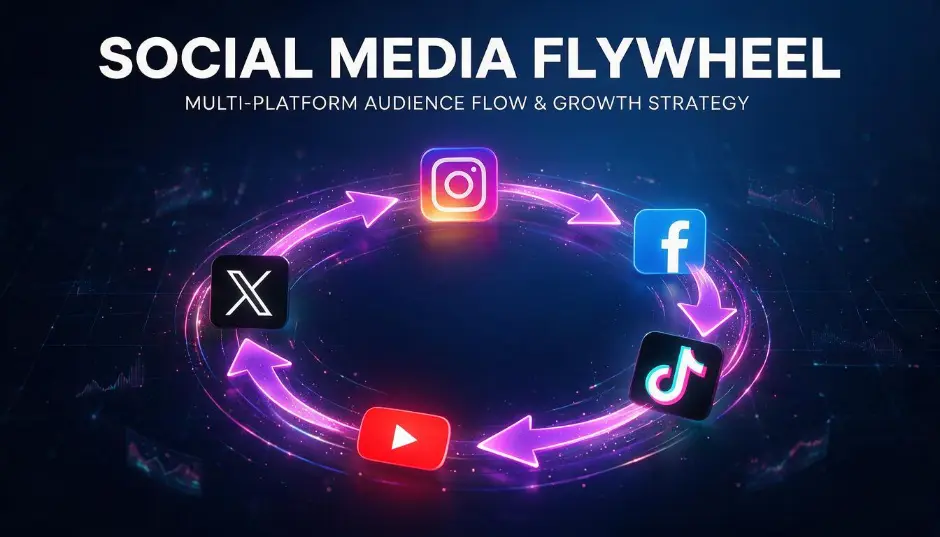
Instead of "follow me on YouTube" — a request without context — create a Twitter thread that covers a topic and says "I went much deeper on this in a thirty-minute YouTube video — here's the link if you want the full version." The bridge provides a genuine reason to cross platforms rather than just asking for a follow somewhere else. Stories and temporary content formats are particularly effective for cross-platform promotion because they feel personal and timely rather than promotional. The flywheel builds slowly but compounds well — an audience that follows you across two platforms is more resilient, more engaged, and significantly harder to lose if any single platform's algorithm or policy shifts against you.
The Platform-Specific Cold Start Problem — Multiplied
Every platform you add to your portfolio has its own cold start problem — the structural disadvantage that new and low-follower accounts face in getting algorithmic distribution before they've accumulated the engagement history that triggers it. Managing one cold start is hard. Managing three or five simultaneously is genuinely difficult in a way that has real implications for how you approach the early stages of building new accounts.
The cold start problem means that new accounts on any platform are fighting for distribution against established accounts that already have engagement history, follower bases, and algorithmic trust. The content quality doesn't matter if the algorithm isn't distributing it to enough people to generate the engagement signals that trigger wider distribution. The follower count matters. The engagement history matters. The starting point matters.
For creators building presence on multiple platforms simultaneously, the timeline for organic cold start resolution on five platforms at once can stretch to years rather than months. Services like GetTwitterRetweet.com exist across multiple platforms — Twitter followers, Instagram followers and likes, YouTube subscribers and watch hours, TikTok followers, LinkedIn followers — precisely because this problem is real and the cost of solving it organically on multiple platforms simultaneously is time that most creators and businesses can't afford. Establishing credibility baselines across multiple platforms simultaneously accelerates the point at which organic content strategy starts generating the compounding returns that make multi-platform presence genuinely worthwhile.
Knowing When to Add a Platform — and When to Hold
Platform FOMO is real and it affects creators at every level. A new platform gains momentum. The case studies appear. The "I grew 50,000 followers in thirty days" stories circulate. The advice to jump in early dominates the discourse. And the temptation to add it to the already-stretched content calendar becomes hard to resist.
You add a platform when your primary platform is genuinely producing sustainable results and you have identified a specific additional audience you want to reach that is meaningfully present on the new platform and not already captured by your existing platforms. Not when a platform is trending. Not when you feel guilty about not being there. When you have the infrastructure to add it without degrading the performance of what's already working. The cost of adding a platform before you're ready isn't just the additional time required — it's the quality degradation that spreads across your existing platforms when the total content creation load exceeds what you can maintain at the quality level your audiences expect.
The staged approach worth holding to: master one platform, build genuine momentum, establish the systems that make it sustainable, then add the second. Master the two-platform system, establish the expanded workflow, then add the third. This feels slower but produces better outcomes at each stage because each addition is built on a functional foundation rather than added to a struggling one.
FAQ: Growing Multiple Social Media Accounts
The Metrics That Actually Matter — and the Sustainable Pace Question

Engagement Rate per Post
The primary quality signal across every platform. Tells you whether the people seeing your content are responding to it. A declining engagement rate is the earliest warning signal that something is wrong — before follower counts move, before reach metrics drop.
Follower Growth Rate
Absolute follower count is less meaningful than the trajectory. Whether it's accelerating, stable, or decelerating. Decelerating growth rate signals that either your reach has dropped or your conversion from viewer to follower has dropped.
Cross-Platform Traffic
The metric that specifically validates your multi-platform flywheel. Are people actually moving between your platforms? Is your Twitter thread driving YouTube views? Tracking referral traffic through link-in-bio analytics gives you a concrete signal of whether cross-promotion is working.
Content Performance by Format
Which adapted content types generate the best return on adaptation time invested on each platform. Some formats will consistently outperform others — tracking this over time tells you where to concentrate repurposing effort rather than spreading adaptation work evenly across all formats.
The honest evaluation of your multi-platform strategy isn't "what's the maximum content volume I can produce across five platforms right now?" It's "what's the content volume across which platforms that I can maintain at high quality indefinitely — not just this month, but eighteen months from now?" The answer is almost always more modest than aggressive strategy documents suggest. Probably two to three platforms rather than five. Probably four to five posts per platform per week rather than daily posting across all of them. Design your multi-platform system for the long game. Build it at a pace you can hold for three years. The platforms you're consistent on in year three are the ones that will have actually built something.
Ready to Solve the Cold Start Problem Across Multiple Platforms?
GetTwitterRetweet.com offers follower, likes, views, and engagement services across Twitter, Instagram, YouTube, TikTok, LinkedIn, and more — so you can establish credibility baselines on multiple platforms simultaneously rather than waiting years for each platform's cold start to resolve organically.
Establish Your Credibility Baseline Across Every Platform
Every platform you're building on has its own cold start threshold — here's how to clear it across all of them simultaneously