New Account? Here's How to Build Credibility on Social Media from Zero
There's a specific kind of silence that greets a brand new social media account. Not the comfortable silence of a room before something starts. The other kind. The kind where you've posted something you're genuinely proud of — something you spent time on, something that represents a real perspective or a real skill or a real business — and the response is four views, zero likes, and a follower count that hasn't moved since you created the account forty-eight hours ago.
It's demoralising in a way that's hard to explain to people who haven't been there. Because it's not just that nobody engaged. It's that nobody even saw it.
Not the sanitised version that tells you to "stay consistent" and "engage with your community" as if those phrases are a strategy. The actual mechanics of why new accounts struggle, what credibility means on social media and how it gets built, and the specific things you can do — starting this week — to move from invisible to legitimately present.
Why New Accounts Are Structurally Disadvantaged — and Why That's Not Your Fault

The first thing worth understanding is that the difficulty of building credibility from zero isn't a reflection of your content quality. It's a structural feature of how every major social media platform is designed. Every platform uses some version of an engagement-based distribution algorithm. The algorithm determines what's "likely to engage" based primarily on historical performance data. Content that has performed well in the past gets shown to more people. Content with no performance history gets shown to almost nobody.
New accounts have no performance history. So they get shown to almost nobody. Which means they get very little engagement. Which means the algorithm continues to treat them as unproven. The loop is self-reinforcing, and it runs against you until you accumulate enough engagement history to break out of it.
Layered on top of the algorithmic disadvantage is the social proof problem. When a real human discovers your profile, they process your visible metrics before they process your content. Follower count. Like counts. Comment activity. These numbers function as credibility signals, and a profile displaying very low numbers triggers subconscious scepticism before a single word of your content has been evaluated. Understanding both disadvantages — the algorithmic one and the social proof one — is the starting point for addressing them intelligently. They're different problems that respond to different solutions, and conflating them leads to strategies that fix one while ignoring the other.
Define What Credibility Actually Means on Your Platform
Before building credibility, you need to know what it looks like in your specific context. It's different on different platforms, and a strategy calibrated for the wrong platform is wasted effort.
Point of View + Engagement Rate
Credibility is built through quality and consistency of public thinking. A clear position, substantive engagement in conversations, and a follower-to-engagement ratio that signals an established presence. Vague, uncommitted posting generates very little traction regardless of consistency.
Visual Coherence + Community
Credibility has a stronger aesthetic component. A credible account looks intentional — coherent grid, production quality appropriate to the niche, visible engagement in comments suggesting a real community rather than a ghost town.
Professional Expertise + Connection Quality
Credibility is expertise-driven. Built through demonstrated knowledge in a specific domain, visible professional history, and content that other professionals in your field find genuinely valuable. Less about follower counts, more about relevant connections and substantive engagement.
View Counts + Content Library Depth
Credibility is almost entirely content-driven. View counts, subscriber counts, and overall production quality of your video library. A new visitor needs enough published content to self-select whether this channel is worth subscribing to.
Most Meritocratic — But Profile Still Matters
The algorithm can push genuinely good content to large audiences regardless of follower count. But profile-level credibility — which affects whether For You Page viewers convert to followers — still depends on follower count, content consistency, and overall first impression.
The Profile — A First Impression You Can't Afford to Waste
Whatever platform you're on, your profile is the conversion layer between someone discovering you and someone deciding to stay. New accounts often spend enormous energy on content while leaving their profile in a state that actively works against them.
Someone sees your content in a search result, a recommended feed, or a share. They're interested enough to click through to your profile. They spend about three seconds there before deciding whether to follow or move on. In those three seconds, they're processing: who is this, what do they post about, and is this worth following? Your profile needs to answer all three questions instantly.
Profile Photo
The smallest but most consistently visible element. It appears in feeds, notifications, search results, and comment sections — and needs to be clear, professional, and recognisable at a very small size. For personal brands and individual creators, a clear face photo dramatically outperforms logos or abstract images. People follow people, and a face signals a person immediately. For business accounts, a clean logo on a solid background works, provided it's legible when scaled down.
Bio / Description
Where most new accounts leave the most value on the table. The instinct is to write something personal and quirky. The problem is that authenticity in a bio doesn't answer the question a new visitor is actually asking: why should I follow this account? The bio formula that consistently works: who you are, what specific value you deliver to followers, any credible social proof, and what to do next. One line each. "Nutritionist helping busy parents cook healthy meals in under 30 minutes. Evidence-based recipes, no fad diets. 10+ years clinical practice. New recipe every Tuesday ↓" — that bio answers every question a potential follower has before they've read a single post.
Pinned Content
Your permanent audition. Whatever you pin is the first piece of content a profile visitor will see, and it needs to be the most impressive thing you've published. Not the most recent. The most impressive. Audit everything you've posted and find the piece that best demonstrates your value. Pin that. A two-year-old tweet congratulating yourself on something nobody else cares about is the wrong pin. A thread that represents your sharpest thinking is the right one.
Content Strategy for Zero — What Builds Trust Fastest
New accounts often make one of two content mistakes. The first is posting too broadly — trying to appeal to everyone and ending up building a coherent identity for no one. The second is posting too infrequently — publishing something excellent and then disappearing for two weeks, which resets whatever momentum the first post started to build.
The content strategy that builds credibility fastest from zero has three characteristics: it's niche-specific, it's consistent, and it prioritises value delivery over self-promotion.
Every time you post something that makes a follower think "I needed that" or "I'm going to save this" or "I have to share this with someone," you've made a deposit into the trust bank that is your relationship with that follower. Every time you post something primarily about you — your achievements, your offers, your milestones — you're making a withdrawal. New accounts have empty trust banks. Lead with deposits. Your first twenty to thirty posts should be overwhelmingly educational, useful, entertaining, or genuinely insightful relative to what your specific audience cares about. Once you've built a relationship with a real audience, you've earned the right to ask things of them. Before that relationship exists, asking for anything other than attention is premature.
Niche specificity is the fastest credibility signal available to a new account — it tells potential followers immediately and precisely who this account is for. Consistency operates on two levels: topic consistency (staying in your lane long enough that both the algorithm and human audiences develop a clear model of what your account is about) and posting frequency consistency (showing up regularly enough that the habit of checking your content can form). Both matter more than any individual piece of content being exceptional.
The Engagement Strategy Nobody Does Consistently Enough
Going out and engaging with other people's content — specifically, in ways that add genuine value rather than just signalling your existence — is the most reliable free method for building credibility, reaching new audiences, and building the relationships that eventually translate into organic follower growth.
Find the accounts in your niche with established audiences. Engage with their content consistently, with replies that add something real — a different angle, a useful addition, a specific question that extends the conversation. Do this daily. Do it for weeks before expecting anything back.
Your replies appear under content that already has significant reach. People who engage with that content see your reply. If your reply is good enough — specific, insightful, clearly from someone who knows what they're talking about — they click your username. Some of them follow you. Over time, the accounts you engage with notice your consistent presence and genuine contributions. Some of them follow you back. Some mention you. Some quote your replies. Each is a distribution event that expands your reach beyond your existing following. And unlike algorithmic distribution, engagement-driven discovery is available to a new account from day one.
People engage once or twice, see no immediate result, and stop. The compounding effect of consistent engagement takes four to eight weeks to become visible. Weeks one and two: planting seeds. Weeks three and four: some germinating. Weeks five and six: you start seeing followers who say "I've been seeing your comments everywhere and finally checked out your profile." That payoff doesn't exist if you stopped at week two.
Collaboration as a Credibility Accelerator
For most new accounts, the fastest route to genuine credibility isn't building it alone — it's borrowing it from accounts that already have it, through collaboration. When an established account in your niche collaborates with you, they're doing something more valuable than just sending traffic. They're providing a credibility endorsement. Their audience's implicit reasoning: "If this account I already trust thinks this new account is worth featuring, that new account is probably worth following." One credible endorsement does more for your credibility than a month of solo content.
Lead with value rather than an ask. Create a piece of content that prominently features or references an established account — a useful breakdown of their framework, a genuine tribute to their approach, a compilation of their best insights on a topic. Share it and tag them. If the content is genuinely good, they'll often share it with their audience because it's in their interest to do so — you've created something that makes them look good, and sharing it costs them nothing. This is not manipulation. It's the oldest professional networking principle on the internet: provide value first, ask for nothing, and let the relationship develop naturally from there.
The Profile Metrics Problem — and How to Address It Honestly
Your follower count and engagement numbers are visible to everyone who visits your profile, and they function as credibility signals that influence whether real potential followers decide to follow you. A new account with seventeen followers is visually communicating something to profile visitors — and what it's communicating, regardless of how good your content is, is "not many people have decided this is worth following yet."
This is the cold start problem in its most immediate form. And while all the organic strategies above are real and they work, they work on a timeline measured in weeks and months. The social proof deficit is doing damage today, right now, to every person who discovers your profile and decides not to follow because the numbers don't inspire enough confidence.
The first is accepting the timeline and investing fully in organic strategies — recognising that the follower count will grow naturally as a consequence of great content and genuine relationship-building, and that the credibility will follow the work. This is true. It just takes longer, and the gap between content quality and visible metrics can be genuinely discouraging in the interim.
The second is supplementing organic strategy with purchased social proof — using a service like GetTwitterRetweet.com to establish a credible baseline follower count while your organic work builds the engaged audience underneath it. The social proof gets you past the credibility floor where potential followers stop discounting your profile before reading your content. The two approaches aren't mutually exclusive. The purchased baseline is the exterior that gets people in the door. The organic content and engagement is the substance that makes them stay.
The Content Formats That Build Credibility Fastest

Beyond strategy, the specific content formats you choose have a meaningful impact on how quickly new audiences trust you. Some formats are inherently more credibility-building than others, and understanding why helps you prioritise.
- Long-form, high-value content — detailed threads, comprehensive carousel posts, deep-dive videos, substantial articles — builds more credibility per piece than quick, light content. It's easy to post a hot take. It's harder to write something a person in your niche would learn something real from. When you consistently do the harder thing, the credibility signal is stronger.
- Teaching formats outperform sharing-opinion formats for new accounts specifically, because teaching establishes expertise in a more demonstrable way. An account that helps you understand something you didn't understand before has proven its value. An account that shares interesting opinions has signalled its perspective. Teaching is more credibility-building for a new account trying to establish authority quickly.
- Results and case studies — real outcomes, documented specifically — are among the highest-credibility formats available. "Here's what I tried, here's what happened, here's what it means" is immediately credible because it's falsifiable. The specificity itself signals confidence in the reality of the result.
- Personal narrative done well — personal experience used as a vehicle for universal insight, not diary-style self-indulgence — builds emotional credibility alongside intellectual credibility. The combination of "this person knows what they're talking about" and "this person understands my situation" is what turns a follower into a loyal audience member.
Credibility Killers New Accounts Don't Realise They're Making
Several behaviours actively undermine credibility for new accounts — and most of them are instinctive enough that people don't realise they're doing them.
A new account that leads with "here's my product/service/offer" before establishing any reason why anyone should trust that offer is asking for something it hasn't earned. The sequence matters: build trust, then introduce the offer. Skipping the first step doesn't accelerate the second — it prevents it.
Showing up strongly for two weeks and then disappearing for three breaks the habit loop your emerging audience was starting to develop. It also signals to new profile visitors that this account might not be actively maintained — a credibility problem that a few weeks of absence creates quickly and takes longer to repair.
Leaving emoji comments, one-word replies, or generic "great post!" responses is worse than not engaging at all — it communicates that you're present but not paying attention. This reads as automated or insincere, which is the opposite of the trust signal engagement is supposed to build. If you don't have something genuine to add, skip it.
On visual-heavy platforms like Instagram and TikTok, a profile that looks visually inconsistent or low-effort creates immediate subconscious scepticism regardless of the content quality underneath. This doesn't mean expensive production — it means intentional production: a consistent colour palette, a recognisable style, a visual approach that signals this account knows what it's doing aesthetically.
Responding to criticism, disagreement, or mild scepticism with visible frustration is a credibility killer that's particularly damaging for new accounts — you don't have enough established trust to absorb the impact. Established accounts can survive a defensive public response. New accounts can't afford to have their first visible interactions be ones where they look thin-skinned.
The Milestones Worth Celebrating and the Timeline Worth Accepting
Building credibility from zero on social media is one of the most non-linear growth experiences a person can have. The early stages feel disproportionately slow relative to the effort going in. The later stages feel disproportionately fast. Setting milestones that acknowledge progress before the big numbers materialise is what makes the journey sustainable.
Your first piece of content that reaches someone outside your existing network — a genuine stranger who found you through search, a hashtag, or a recommendation rather than from already knowing you. For most new accounts, the first several posts are seen almost entirely by people who already know you. The first post that reaches a genuine stranger is the first proof that the growth engine is starting to turn.
Someone who not only followed but commented, replied, saved your post, or sent a DM. This person has moved from passive observer to active participant — and that transition is the beginning of a real audience relationship rather than a vanity metric. One genuine engaged follower is worth more to your long-term growth than fifty passive ones.
When your engagement starts arriving from sources you didn't generate yourself — a stranger sharing your content, a new follower who says "someone recommended your account," a comment from someone who found you through someone else. This organic propagation is the compounding effect starting to work. Once it starts, the timeline changes dramatically. Most accounts building with deliberate strategy reach this milestone somewhere between three and six months in.
FAQ: Building Social Media Credibility from Zero
The Foundation Is the Work
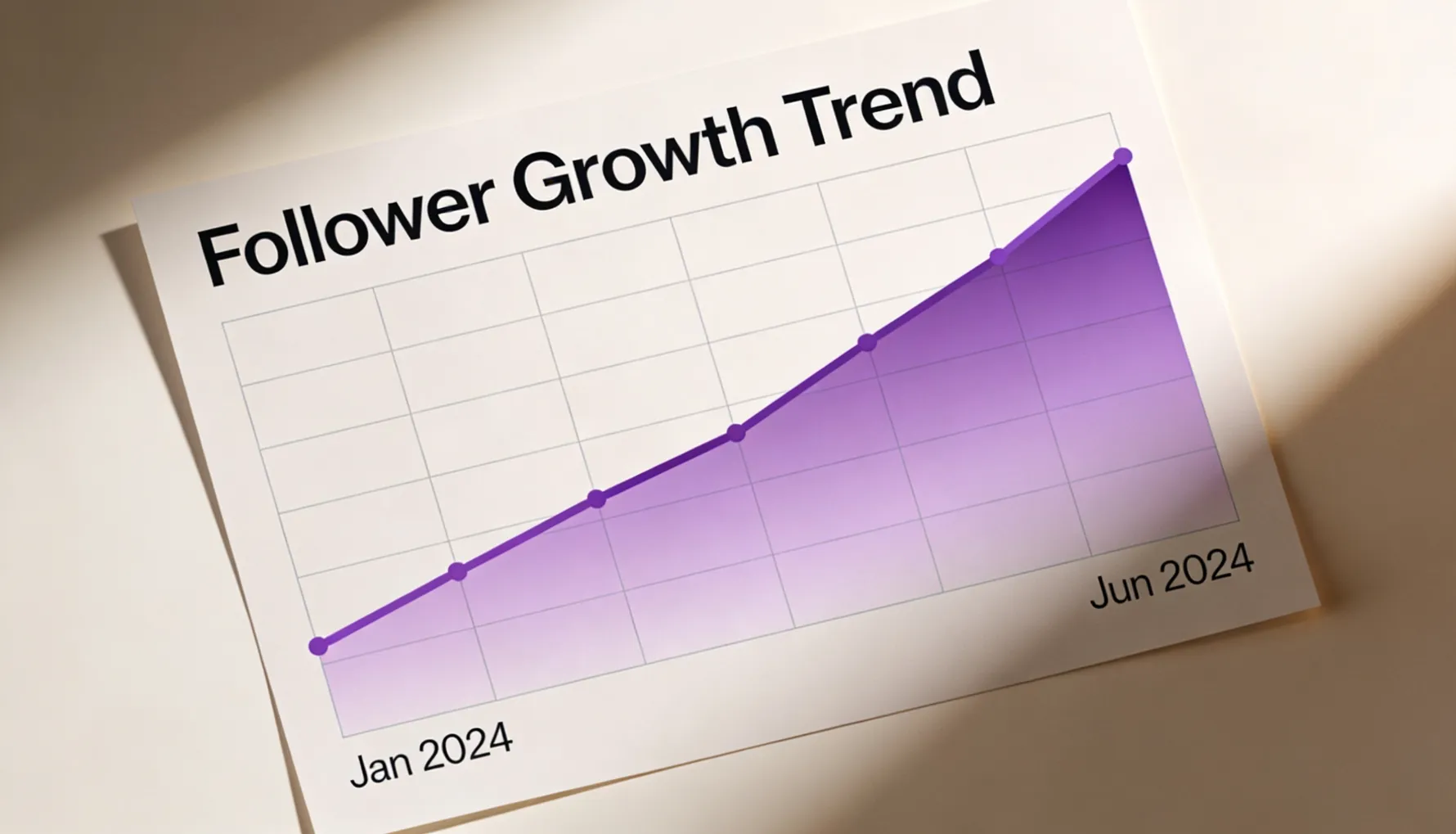
Building credibility on social media from zero is a systems problem, not a talent problem. It requires clear understanding of how each platform's algorithm works, a profile built to convert the visitors you earn, content calibrated to build trust rather than just accumulate views, engagement executed with enough consistency and quality to build real relationships, and the patience to let the compounding effect run long enough to become visible.
None of these is particularly glamorous. All of them are learnable. And the accounts that look enviably credible from the outside — the ones with the engaged communities and the brand partnerships and the follower counts that keep growing on autopilot — got there the same way you will.
They understood the system. They worked the system consistently. They stayed long enough for the compounding to start doing the heavy lifting. That's available to you. The timeline is yours to compress with smart execution, and the starting point is wherever you are right now. Start there. Build forward. The credibility comes with the territory.
Ready to Close the Social Proof Gap on Your New Account?
GetTwitterRetweet.com helps new accounts establish a credible baseline — high-quality followers delivered gradually, so your profile gets evaluated on its actual merits rather than filtered out before it's read.
Get Past the Credibility Floor — On Every Platform
Quality follower services that help new accounts get evaluated rather than filtered out before a word is read